2026 – Acoustic propagation modeling on a quantum computer simulator
 |
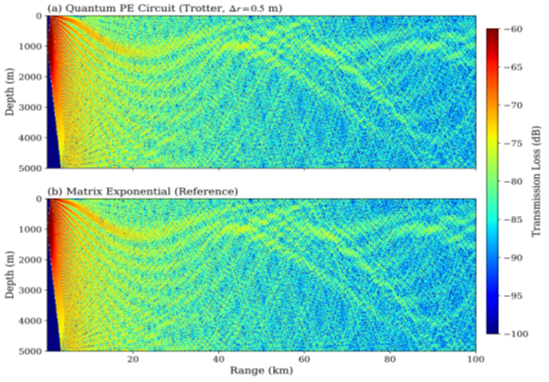 Comparison of a Quantum computer simulator with the Suzuki Trotter circuit in panel (a) with a PE model simulation on a binary computer in panel (b). |
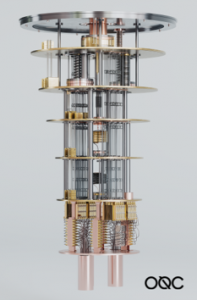 Image of a quantum computer from OQC |
Quantum computing (QC) uses the principles of quantum mechanics to perform calculations at extremely high speeds and is a very fast growing area that has the potential to transform scientific research. But it requires an entirely new way of thinking about computation.
Quantum computers have the potential to address problems that no classical computer will be able to solve. Applying QC to practical underwater acoustics will be necessary but remains non-trivial. Acoustic propagation methods will have to adapt to this new methodology.
Noriyuki Kushida (WHOI) and Y-T Lin (SIO) have demonstrated the first application of quantum Hamiltonian simulation to the PE method for long-range underwater acoustics which is described in the Acoustical Society of America POMO publication A quantum computing framework for finite-difference time domain and parabolic equation models in ocean acoustics’. Proceedings of Meetings on Acoustics, Vol. 60, 022003 (2026); https://doi.org/10.1121/2.0002281